When an alert fires at 3 a.m., the first rule is not to trust the number on the page. Check what's actually being measured. Half the time the graph is right and the metric is wrong.
On 26 October, Anthropic filed its to list on Nasdaq as ANT. Within a day, the alert was everywhere: an $80.7 billion loss in six months. I opened the filing expecting to find a company on fire. I found a metric that measures the wrong thing, a real signal three tables further down, and one blank space that I think matters more than all of it.1The S-1 is on SEC EDGAR, filed 26 Oct 2026. It's a very long document; the numbers here are from its statements of operations and quarterly results, not from press coverage.
So here's the filing, read like an incident.
The alert: $80.7 billion
| Six months to 30 June | 2025 | 2026 |
|---|---|---|
| Revenue | $1,163M | $16,286M |
| Operating loss | ($2,135M) | ($693M) |
| Net loss | ($12,969M) | ($80,748M) |
Two things are true at once. Revenue went up 14x in a year, and it's booked revenue, not a guess.2The filing has no run-rate figure at all. For scale, Anthropic's revenue for the whole of 2023 was $41M. And the loss went up six times.
Quarter by quarter the revenue looks less like a line and more like a wall: $376M, $787M, $1.4B, $2.0B, $4.7B, $11.6B. More than two thirds of the half year landed in a single quarter. Some of that is people like me: an engineer in India who now has Claude open in a terminal most of the working day and pays for it in dollars.
The false positive: most of the loss never left the bank
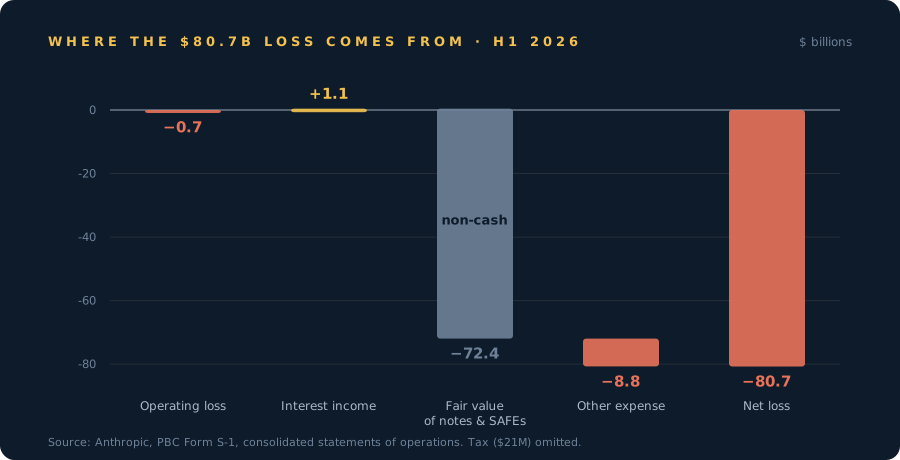
$72.4 billion of the loss is one line: "change in of , derivative liabilities, and ".
Anthropic raised a lot of its money through instruments that turn into shares later. When the company became worth more, those future shares became worth more, and accounting books that increase as a loss. No cash moved. The better the company did, the louder this alert got. It's the financial version of a latency dashboard that counts retries as failures.3Another $8.8B sits in "other expense". The filing groups it with the non-operating items, below the operating line.
Strip it out and the business itself lost $693 million in six months. That's the , and the clearest way to see it is to follow a single dollar.
Every $1 of revenue in the first half of 2026 went out as about 55¢ on compute, 19¢ on people, 19¢ on sales and partners and 11¢ on everything else: $1.04 spent per $1 earned.
So "Anthropic lost $80 billion" is technically true and mostly wrong. But "Anthropic is basically profitable" is wrong too, and the reason is the part I actually care about.
The real signal: what a dollar of revenue costs in GPUs
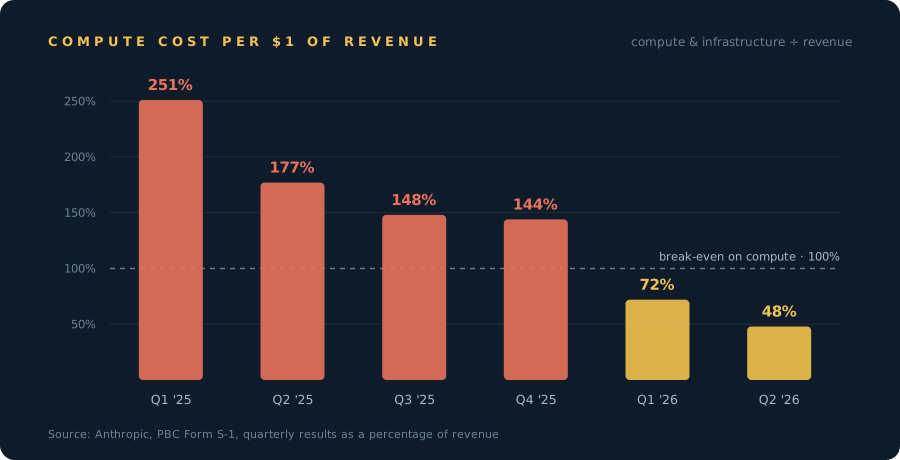
The filing breaks every quarter down as a share of revenue. The compute and infrastructure line goes 251% → 177% → 148% → 144% → 72% → 48%.
In early 2025, every dollar Anthropic earned cost it $2.51 in GPUs and data centres. By mid-2026 it cost 48 cents. The compute bill itself still grew six times, from $944M to $5.6B a quarter. Revenue just outran it.
Open the books: every quarter, $M
| Quarter | Revenue | Compute | Share | Op. result |
|---|---|---|---|---|
| Q1 2025 | 376 | 944 | 251% | (935) |
| Q2 2025 | 787 | 1,390 | 177% | (1,200) |
| Q3 2025 | 1,382 | 2,047 | 148% | (3,089) |
| Q4 2025 | 2,040 | 2,945 | 144% | (2,836) |
| Q1 2026 | 4,731 | 3,387 | 72% | (1,667) |
| Q2 2026 | 11,555 | 5,558 | 48% | 974 |
Q3 2025 includes the one-off $1.5B Bartz settlement, the authors' copyright case.
This is the line I'd frame. It's what an AI lab learning to make money looks like, and nobody gets there with accounting. You get there with engineering: batching, caching, routing requests to the right hardware, keeping every GPU busy. In Field Note 002 I wrote about splitting LLM serving into prefill and decode so each runs on hardware that suits it. That kind of unglamorous work is how 251% becomes 48%.
It's also my day-to-day work. Most of my open-source time goes into KAI-Scheduler, a Kubernetes scheduler for GPUs. In that world an idle GPU is a bug report. Reading this filing, I realised it's also a line on a balance sheet.
The open risk: a blank in the filing
"…with an aggregate committed spend of more than $ , substantially all of which is related to compute and infrastructure." The amount is blank in the S-1.
Buried in the risk factors is the sentence I keep coming back to. Anthropic has signed purchase commitments and leases "with an aggregate committed spend of more than $ ,". The number isn't filled in yet.
What the filing does say: most of it falls between 2031 and 2045, and much of it is , owed whether or not the compute gets used.4The Wall Street Journal has reported the total could reach $750B. That's a press report; the S-1 leaves it blank. Same for the reported $1.5–2T valuation and a mid-November listing: price, share count and raise size are all blank in the filing.
This is where it stops being about one company. Commitments that run to 2045 are power plants, substations and buildings that someone has to pour concrete for now. They get paid for by revenue that the company itself says will grow more slowly: the filing warns its growth "may not be sustainable" and that it expects the rate to decline.5That's standard S-1 language. Here I'd take it literally. A 14x year is not a trend line.
Fixed costs to 2045 against variable revenue is a familiar shape to anyone who has run infrastructure. You reserve capacity for the peak you expect, and you pray the traffic shows up. Here the reservation is measured in hundreds of billions and in decades.
What I'm taking from it
For me the headline loss is noise. The real story is a cost curve that engineers are bending and a commitment that leaves no room to stop bending it.
For people who build on these models, that's the part that reaches us. If compute per dollar keeps falling, prices can come down and margins can hold. If it stalls, the bill until 2045 still arrives, and someone pays it: investors first, then probably us, in the price per token.
I'd watch two numbers from here. The next quarter's compute share, and whatever finally goes in that blank.
Sources: Anthropic, PBC Form S-1 (SEC EDGAR, filed 26 Oct 2026) · Anthropic's announcement · Reported, not in the filing: valuation, timing and the $750B figure (The Next Web, Dealroom on the WSJ report)
Somoprovo, by firelight 🏕️